
Rain on the Window, Guitar in the Room: A Seedance 3.0 Music Video Sketch
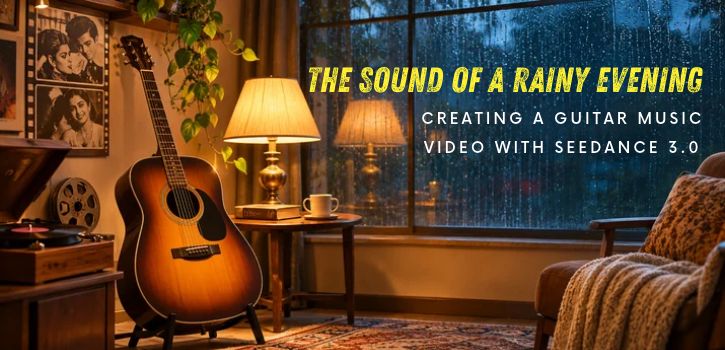
The last note of a fingerpicked guitar phrase hangs in the air while rain catches the light beyond a window. That is the image I would build around an original instrumental recording. The proposed music video would stay inside one room, using reflections, a lamp, and the shape of a guitar to give the melody a visual companion without illustrating every note literally.
My materials would be a recording I own, a photograph of a guitar resting on a stand, and a simple room reference. I would select a short passage with an opening phrase, a change in harmony, and a clear ending. Those musical landmarks would guide the edit. The project would not require a fictional performer or a borrowed song to establish its mood.
Listen for a change that deserves an image
I would listen several times before writing a visual direction. A brighter chord might suggest a wider view of the room, while a held bass note could support a slower movement across the window. I would mark those moments in an editing timeline. The video should respond to the phrase’s shape, rather than cut mechanically every time a string is plucked.
The opening would be close enough to show drops on the glass but not so close that the room disappears completely. A soft reflection of the lamp would connect the window to the interior. I would keep the palette limited to warm amber inside and cooler blue outside. That contrast would give the sequence structure without requiring a different location for every musical section.
At the point where the melody opens up, Seedance 3.0 becomes a way to explore the room as moving imagery. I would combine the visual reference with a brief describing a slow shift from the rain-streaked window toward the lamp. The movement would follow the musical phrase’s expansion, giving the sound a change in visual space instead of a literal illustration.
Keep the instrument recognizable
The guitar would appear in the second composition, resting on its stand beside the lamp. I would choose a photograph with a clear body outline and a visible neck, avoiding reflections that make the instrument difficult to read. Its finish and broad shape would remain consistent across the sequence. The viewer should recognize the same object when it returns near the ending.
For this Seedance 3.0 shot, I would request a gentle sideways camera movement with the guitar stationary. I would not generate fingers playing the recorded passage. A convincing instrumental visualizer does not need to pretend that the image documents a performance. If I wanted to include playing, I would record the actual musician and place that footage clearly within the edit.
A draft might change the number or alignment of visible strings, or let the neck bend as the camera moves. I would inspect those details and shorten the movement if necessary. A quieter shot with stable proportions would serve the music better than a dramatic orbit that makes the instrument look unfamiliar. The revision should protect the object the viewer is meant to notice.
Let the harmony determine the transition
When the recording moves into its contrasting chord, I would cut back to the window from farther away. The lamp reflection could now sit near the edge, with the guitar visible as a soft shape in the foreground. That composition would connect the room’s elements while giving the music a little more air. The visual change would arrive because the phrase changes, not because a timer demands another shot.
A Seedance 3.0 draft of this wider view would need only a modest shift in focus. I would move attention from the interior reflection toward the rain beyond it, keeping the camera mostly still. If the glass begins to distort the room excessively, I would simplify the reference and reduce the amount of reflected detail. The effect should be readable before it is elaborate.
I would avoid filling every pause with movement. A held image can let the guitar’s resonance become the active element. The music already contains texture, timing, and variation; the video does not have to compete with all of it. I would leave one passage almost still, then let the return of the opening motif bring a small camera movement back into the sequence.
Protect the original recording
The finished soundtrack would use the approved instrumental master. Any generated audio would be treated as an optional draft element, not a replacement for the musician’s performance. I would check for extra notes, ambient voices, or rain that becomes louder than the guitar. If a subtle rain layer helps, I would mix an authorized recording quietly beneath the original track and compare both versions.
While reviewing Seedance 3.0 outputs, I would listen separately from watching. A visually attractive clip can distract me from a sudden audio change. I would then return to the full edit and make sure the cuts respect the recording’s phrasing. The final note should be allowed to decay naturally unless the musician deliberately wants a sharper ending for a particular format.
For a short social excerpt, I would choose a complete musical thought rather than an arbitrary number of seconds. The excerpt could begin just before the brighter chord and finish after its resolution. That would give the listener a small arc. I would adapt the visuals to that arc, keeping the window and lamp as recognizable elements even when the sequence is shorter.
Return to the first image with a different feeling
The closing Seedance 3.0 shot would bring the window back into view, now with the lamp slightly farther from the center. I would leave an uncluttered area for the track title and artist credit, added accurately in the editor. The rain could continue after the last note, but only briefly. A long visual tail might weaken the sense that the musical phrase has finished.
I would prepare a portrait version by placing the guitar low in the frame and keeping the window reflection above it. A crop of the landscape image might lose the lamp or cut the neck awkwardly. Planning a separate composition would make the vertical version feel intentional. I would check both exports on a phone to see whether the small details remain visible.
The final Seedance 3.0 sketch would move between rain, instrument, and reflected light, with each change tied to something audible in the original recording. I would review the sequence once without titles and once with them, making sure the credits do not interrupt its rhythm. The result I would aim for is a modest music video that gives a guitar phrase room to linger and a visual atmosphere of its own.


